Company Profile
Brand: Schubert & Salzer (Germany)
Founded: 1920
Product series: sliding-window control valves
Main certifications: ISO quality management system certification, EXAM explosion-proof product certification, classification society product certification
Carl Schubert and Bruno Salzer set up a factory in Chemnitz, in western Germany, to manufacture knitting machines. 1885: the German Royal Ordnance Factory and the Royal Laboratory began research and manufacturing of military equipment in Ingolstadt. 1920: the Royal Ordnance Factory and the Royal Laboratory began converting military technology to civilian use, applying it widely in the casting, valve and textile industries. 1925: the Royal Laboratory renamed their company "Deutsche Spinnereimaschinenbau AG Ingolstadt". 1938: Schubert & Salzer AG acquired a shareholding in DESPAG and, after the Second World War, moved its offices to Ingolstadt. 1987: Rieter AG, Winterthur (Switzerland) acquired the majority shareholding in Schubert & Salzer AG. 1992: the textile design plant of Schubert & Salzer AG was renamed Rieter Ingolstadt AG, while the name Schubert & Salzer was retained for the casting and valve companies: Schubert & Salzer steel castings, investment castings, domestic water supply valves, control systems and industrial valves.
Products
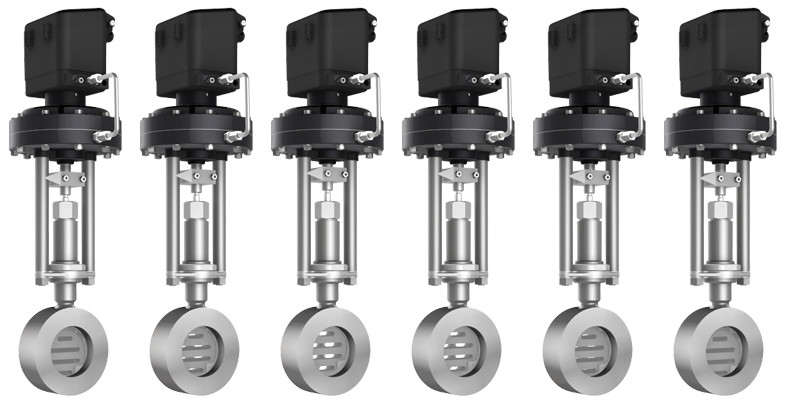
● Sliding-window control valves / slide valves
● Lightweight design, time- and effort-saving installation (see the picture above): the valve body is simple, with wafer-type flangeless mounting and low body weight. Thanks to the unique throttling method, the unbalanced force on the plug is small (1/10 of that on a single-seat valve), so a smaller actuator is sufficient and installation space is saved. No lifting equipment is needed for installation. The larger the size, the relatively less material is used and the lower the purchase cost.
● Short stroke: as shown in the picture on the left, the full stroke is only the height of one window. The stroke of a sliding-window valve is 2 mm to 18 mm, compared with 20 mm to 160 mm for conventional valves.
● Wide rangeability: because the unbalanced force acting on the sliding-window valve is small, the maximum rangeability reaches 40:1 and the practical rangeability is above 30:1; the valve still works stably over the long term at small openings.
Applications
Food ● Pharmaceutical and hygiene ● Laboratory